
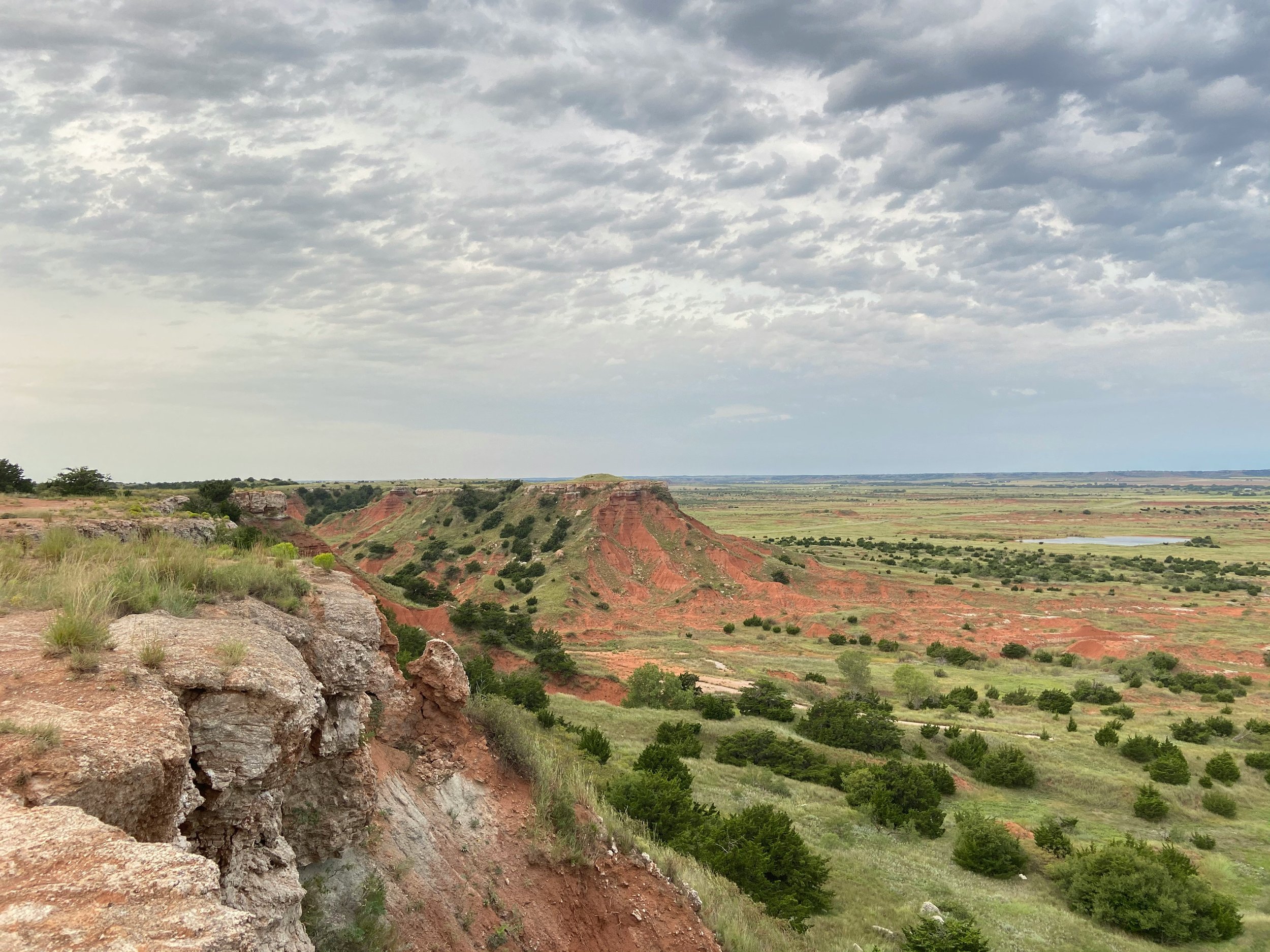

Written by Hannah Maaßen
Hannah is studying her Research Master’s in Modern History & International Relations at the University of Groningen. This essay was submitted as part of the Theory of Modern History and International Relations course. Hannah researches how wars, especially those entities already marginalised in wars, are portrayed by International Relations scholars.
Remaking Worlds: Wilma Mankiller’s approach to developing the Cherokee Nation within the US State
Sunlight and Dreams
The unreasonably warm day marked the end
of a bitter, icy winter
as Sun graciously warmed the Earth
tender young plants stretched and pushed their way up through the soil
to gratefully lean into her nourishing light
A tiny wisp of wind whispered through the infant plants
urging them to dance in the late
morning sun
The People were in ceremony to acknowledge
changing seasons
offer thanksgiving prayers for life
and the generous gifts of the Earth
As the sweet laughter of children rang
out in the heart of the village circle
everything seems perfectly in balance
then suddenly things shifted and changed
the sky filled with angry dark clouds
hiding the sun and blocking out the light
The violent sounds of the Thunder Beings shocked
everyone into silence
A hard, ill wind darkly spun its way
through the treetops
down to the Earth
It was a northerly wind
North
The land of blue-veined people
North
The land of death
North
The color of blue
The North wind caused the sun to hide
while it swept away the People’s dreams
(Mankiller 2022)
—
“A settler-colonial relationship is one characterized by a particular form of domination; that is, it is a relationship where power […] has been structured into a relatively secure or sedimented set of hierarchical social relations that continue to facilitate dispossession of Indigenous peoples of their lands and self-determining authority” (Coulthard 2014: 7).
Many things are not graspable in academic language. Reading about settler-colonialism, even from a critical perspective, as form of domination including territorial dispossession draws attention to the factual, the unequal, the violence. But Mankiller’s (2022) poem – at least for me – tricked my brain into experiencing the sadness of the loss of balance and of dreams.
It is the same for the language of Geopolitics: while it is often talked about those who invade other countries or those whose ideas and strategies ‘win’ in the game of geopolitics, those who are invaded or ‘loose’ are left out of the history. Aim of this paper is to provide insight into one of those whose world were taken. What is happening to those who loose in the game of Geopolitics, those who are still living in a system they do not call their own. One example for those entities are the Native American Tribes in the USA, which are placed in a system of gradual sovereignty and are considered pre-constitutional, as being able to exercise sovereignty without constraint of US-state law in their reservations (Biolsi 2005: 241, 243). But while the US-recognized tribal sovereignty is limited: Congress “can reduce tribal powers at will, and has done so” (ibid.: 243). Therefore, there is a continued struggle within the established state of the United States for sovereignty of Native Tribes.
Bell (2013: 257) argues that social science studies practices of world making and the symbolic construction of worlds. Worlds are constructed with a particular interest in mind, and while all humans participate in worldmaking by stabilising existing worlds, theys can also be taken away: for example by Imperialism, a technology to take and remake worlds (ibid.: 261). The destruction of Native worlds means “to lose not only its physical infrastructure and living traditions but its very concepts” (ibid.). Still, “most instances of world taking are not [complete] but they nevertheless involve displacement, rupture, and disorientation” (ibid.). Loong (in Constantinou et al 2024: 6-8), argues that Indigenous self-determination “can be conceptualised as worldmaking: an effort to build relations between humans […] and non-humans, that challenges relations of colonial domination” (ibid.: 6). Therefore “self-determination claims not only reach ‘up’ into the space of international politics, but ‘down’ into the relations between people and the ecosystem they inhabit” (ibid.: 7).
This paper investigates how this struggle for sovereignty and for an own world is manifested in Indigenous politics by looking at the writings and politics of Wilma Mankiller, the first female chief of the Cherokee Nation (1985-1995), who took part both in shaping the Cherokee community and the nation-to-nation relationship between Cherokee and US government. In combination with the introduced a three-folded approach to Mankiller’s thought is taken: How was the world of the Cherokee Nation taken away and to what extent? How did settler-colonialism make the Cherokee world anew and how is the old world still present? How do the two different worlds (US-Americans v Native Americans) interact with each other from the Cherokee perspective? This will be conceptualised by focusing on three aspects of Mankiller’s writing: removal, community, and balance. These themes occur throughout the investigated literature and reflect on both the internal aspects of the Cherokee and the nation-to-nation .
While there are multiple interesting and understudied time-periods and Indigenous people to investigate, I chose Mankiller for several reasons: Firstly, as Cherokee, woman, and a chronically ill person she is in many ways the Other in the societal and political structure. Secondly, there are multiple speeches, books and textual sources available in English. Thirdly, and more personally, her speeches and texts are easily graspable for a non-native person and show a side that I – at least – did not encounter in the media I consumed about Indigenous people: funny, resilient, and bridging the knowledge-and worldview gap. The research question investigated in this paper is the following:
“How does Wilma Mankiller use the tropes of removal, community and balance in her politics of developing the Cherokee Nation and the nation-to-nation relationship?”
Literature and Justification
Admittedly, writing a paper about Geopolitics and Intellectual History about Wilma Mankiller, an activist and politician within the well-established USA, whose main period of work was after most of the in hindsight big developments of the nation-to-nation relationship, seems like a stretch. I argue that Mankiller provides insight into multiple topics of interest for both Political Geography and Intellectual History.
The paper intersects with a growing strand of literature in Political Geography that challenges challenging the elite-, western-, euro- and state-centric understanding of world-politics (Agnew 2004; Zarakol 2011). It furthermore falls within the strand of Political Geography that engages with non-dominant Geopolitics, for example Altergeopolitics (Koopman 2011), Subaltern Geopolitics (Sharp 2013), liminal/marginal geopolitics by non-state diplomats (McConnell et al 2012; McConnell 2017), and paradiplomacy (Jackson 2017).
It is also informed by literature on Indigenous Geopolitics. Dealing with multiple issues, for example, a framework of Indigenous Geopolitics, which is looking at indigenous communities that establish peace-zones in conflict (Macaspac 2013); a reconceptualization of the 20th centuries Native American Movement as geopolitical/georestorative (Pesantubbee 2011); an investigation of the imagined spaces and political geographies of Native communities (Biolsi 2005); or the intersection of self-determination and political geography (Constantinou et al 2024; Kuokkanen 2019; Murphy 2014). They engage with Indigenous community building and sovereignty efforts despite dominant, violent, settler-colonial and heteropatriarchal histories and structures. The focus on non-dominant and Indigenous Geopolitics incorporates every day, sub-state geopolitics.
Another strand of literature engages with Intellectual Indigenous History. Intellectual History is the Method adopted in this paper.
McGrath and Russel (2021: 1) argue that “to draw lessons from the human past, the global scale and scope of Indigenous history is an illuminating place to start”. Indigenous history is viewed as global, and including “long struggles to regain sovereignty over ancestral lands” (ibid.: 2). It is important to view history not only from an imperial lens but to foreground the Indigenous perspectives (ibid.: 3).
Belmessous (2011: 3) investigates Indigenous legal claims in relation to colonial power. It uses a contextual methodology “to understand past peoples on their own terms” and not from the dominant western point of view (ibid.: 6). The author emphasizes the need of understanding of colonial and global history from an Indigenous angle (ibid.: 13). The contextual approach of this paper both provides more insight into Indigenous history and an understanding of the specific politics of Mankiller from a close reading of the texts.
The paper will first introduce Wilma Mankiller and the formative context for her life and the texts investigated. Using the method of Intellectual History the texts will be read in light of the formulated research question, while focusing on the tropes of removal, community and balance. In reflection of the structure of the main source, each chapter is introduced by a segment of a poem Mankiller wrote. Lastly, the findings will be summarized and critically reflected on.
Making a Nation: Wilma Mankiller’s world-building inbetween worlds
Reality {again}
When the land darkens, I close my eyes
and dream of a world of my own making
Visions of druids, stars, the fire,
trees that whisper ancient secrets
I dream into existence a universe
without hatred,
where no one betrays me
In sun’s warm light, I care about Cuba,
South Africa, Jemez Pueblo, Navajo,
Bosnia and Jay, Oklahoma
Some would say
not womanly things to care about
[…]
(Mankiller 2022)
The poem Reality {again} talks of the lost opportunity to live in a world of the own making, on the connection between international struggles of power-less against power-ful. The issue of a world forced-upon the powerless, who still struggle for their own world is the connecting threat of this Essay.
Formative Context and main sources
In the following, Wilma Mankiller’s life is put in the social and political context. Mankiller tells her life in context of the Cherokee History and states, “in the context of a tribal people, no individual’s life stands apart and alone from the rest. My own story has meaning only as long as it is a part of the overall story of my people. For above else, I am Cherokee women” (Mankiller and Wallis 1994: 14). Given this interrelatedness of past in present, the formative context is necessarily a long one. There is literature engaging with Native Histories (e.g. Couldhart 2014), Native Resistance (e.g. Cobb 2015), US-settler colonialism (e.g. Couldhart 2014) and Cherokee female histories (e.g. Johnson 2003). The history of the Cherokee Nation and the nation-to-nation relationship are complex, and often written from a western perspective; therefore a more substantive engagement is out of the scope of this paper. Mankiller herself uses oral history of the Cherokee Nation and other sources and draws connections and retells the history of the Cherokee Nation. This paper will therefore mainly draw on those accounts on the Cherokee History to contextual Mankiller. A fact-check will not be done, as aim is not to retell a ‘correct’ History, but to investigate Mankiller’s thought.
Wilma Pearl Mankiller was born in 1945 in Oklahoma and raised on the Mankiller Flats, a land allotted to her grandfather in 1907. Mankiller’s family took part in the Relocation Programme of the federally-organized Bureau of Indian Affairs (BIA) in 1959 and moved to California (Mankiller 2009: 8). Mankiller was married twice, had two daughters and was elected as first female Chief of the Cherokee Nation and served between 1985 and 1995. After her death in 2010 Barak Obama, then US-President, released a statement in which he described the Recipient of the Presidential Medal of Freedom, as having transformed the Nation-to-Nation relationship and being inspirational for both communities: “Her legacy will continue to encourage and motivate all who carry on her work“ (Obama 2010). Mankillers life was shaped in her own accounts by being Cherokee and woman – and by multiple crisis of health: a kidney disease, a serious car accident, an auto immune disease and cancer. Especially after the car accident, in which the other party – a good friend of hers – died (Mankiller and Wallis 1994).
She describes that she became politicised during 1968 and 1969, specifically by the Social Movement and during the occupation of Alcatraz’ by members of different Indigenous tribes (Mankiller and Steinem: 50).
Cobb (2015: 153) states that from the late 1960sto mid-1990s Native American rights were linked to decolonization and all native tribe. The occupation of Alcatraz’ was followed by formulations of intellectual and philosophical elaborations on the connections of Indigenous around the world (ibid.: 153). As result of various movements advocating for rights of Indigenous nations in the 1970s, the federal government started following approaches founded on the principle of self-determination (ibid.: 154). In 1975 the Indian Self-Determination and Education Assistance Act was passed in Congress to respond to demands for more power and limiting power of the BIA (ibid.: 199). This act was still criticised for lacking self-administration rights (ibid.).
Mankiller was especially engaged in community development (Mankiller 2009: 17). During the most prominent one, the Bell Community Revitalization Project of 1981, she was appointed head of the Cherokee Nation Community Development Department (Agnew 2001: 214). The Bell Project inspired similar projects (ibid.: 220). Mankiller was, after two years of being Deputy Chief to David Swimmer, appointed his successor in 1985, and elected twice as Chief of the Cherokee Nation in 1987 and 1992 (ibid.: 219, 225). Agnew (2001) specifically deals with Mankiller as tribal leader and her contribution to the Cherokee Nation (ibid.: 211). While Mankiller criticised injustices “the communication skills that had made her effective at grassroot levels were equally effective when she began working with state and national leaders” (ibid: 218). She became a prominent figure in the public discourse (ibid.: 218f). In 1990 Mankiller negotiated an agreement with the BIA for the Cherokee Nation to participate in a self-government demonstration project (ibid.: 224).
Cobb (2015: 199) describes the Tribal Self-Governance Project as a response to Reagan's government-to-government rhetoric in 1990 which “enabled select tribes to enter into compacts with the federal government. These compacts provided for tribal control over the administration and management of Indian Bureau programs, functions and” (ibid.: 199). This agreement was reflecting a mature relationship between two sovereignties with their own governing capabilities (ibid.: 200).
The main sources are the books A Chief and her People (Mankiller and Wallis 1994) and Everyday is a good day: Reflections by Contemporary Indigenous Women (Mankiller and Steinem 2011). Other texts, interviews and speeches are used supplementary. The texts are published in English and targeted at both Cherokee and non-Cherokee.
A Chief and her People is an autobiography, published during Mankillers second and last term. Each chapter is started with a Cherokee Oral History, and the book contains both Mankiller’s personal life history and a retelling of the Cherokee history.
Everyday is a good day is a collection of oral history, discussions, vignettes and stories from nineteen Indigenous women, including Mankiller, at gatherings (ibid.: xxviii). The post-hum published book aims give insight into “a small, diverse group of women who made a conscious choice to lead a meaningful life by building on the positive attributes of their community instead of focusing only on the daunting set of economic and social problems they deal with daily” (ibid.: XXIX). It seems to be written for a feminist, post-colonial audience familiar with Indigenous rights.
Removal: The world taken
Throughout the sources investigated Mankiller emphasizes the entanglement of past and present of the Cherokee nation and the relations to the US. Especially in focus is the history of violence, removal and betrayal (in context of broken treaties). The entanglement of past and present becomes most evident in the retellings of the history of removal as shaping the Cherokee Nation and the nation-to-nation relationship.
In relation to the societal problems the Cherokee Nation faces, Mankiller sais: “To understand the contemporary issues we’re dealing with today and how we plan to dig our way out and how indeed we are digging our way out, you have to understand a little bit about history. Because there are a whole lot of historical factors that have played a part in our being where we are today” (Mankiller 02.04.1993).
Cherokee seem to be doomed to revisit some of their blackest histories: “Much of the repetition of our history concerns ownership of land and property rights” (Mankiller and Wallis 1994: 62). The emphasizes on the past and the history of violence and removal is especially evident in the reoccurring reference of Mankiller to the Trail of Tears, which is one of the instances in which the Cherokee world was ‘taken’ by forcefully removing Cherokee from their homelands. The narrative of removal is told not as a process that has ended, but as ongoing, constant attempt of the US government to disrupt and destroy the Cherokee .
In the Autobiography the removal (in form of the trail were they cried and her own re-location) is introduced with a oral history: Before the Cherokee were driven from their homes in 1838, they were being warned of wars and misfortunes by the Nuñnehi, non-human entities (Mankiller and Wallis 1994: 45f). The Nuñnehi invited the willing Cherokee to live with them in mountains or under water (ibid.). Once of the greatest regrets of the forced removal was “that they were compelled to leave behind forever their relative who had gone to the Nuñnehi (ibid.: 46). The Nuñnehi appear in multiple passages (e.g. ibid.: 163 in context of the Alcatraz occupation) and highlight the deep entanglement of Cherokee with their homeland and the past.
The removal was result of President Jackson not accepting the Cherokee constitution and claiming that “Indians had no right to occupy land within the United States” (ibid.: 87). Against Indian resistance, and their commitment to restore the Cherokees balance, the Indian Removal Act of 1830 was against enacted and between 1838 and 1839 the Cherokee were forcefully removed (ibid.: 87-89). The Trail of Tears was walked by seventeen thousand Cherokees, a few whites, free black people, and slaves: It “our holocaust” – with the worst part being “the continued loss of tribal knowledge” (ibid.: 47).
Mankiller describes that she experienced her own Trail of Tears when the BIA through the Relocation Programme in the 1950s tried to solve “the ‘Indian problem’” by removal (Mankiller and Wallis 1994: 62).
“I learned through this ordeal about the fear and anguish that occur when you give your home, your community, and everything you have ever known to move far away to a strange place […]. I wept tears that came from deep within the Cherokee part of me. They were tears from my history, from my tribe’s past. They were Cherokee tears” (Mankiller and Wallis 1994: 62).
For Mankiller’s family the relocation was understood as opportunity to get a better life (Mankiller and Wallis 1994: 69). The family didn’t have to participate: “We could have stayed. You had a choice. You weren’t forced to go. It was more a matter of guilt-tripping parents” (Mankiller 2009: 8). For Mankiller the Relocation Programme was a repetition of History, but this time, “Instead of guns and bayonets, the BIA used promotional brochures showing staged photographs of smiling Indians in ‘happy homes’ in big cities” (Mankiller and Wallis 1994: 69).
This segment shows how the removal took not only the literal people away from their their homeland but how the Cherokee themselves did not negotiate or resist anymore, but accept the new world in which the US government decided for them.
Later, Mankiller reflects that although her relocation was disturbing in retrospect it
“was not nearly as harsh or painful as the problems encountered by the Cherokee people who had been forced to take the Trail of Tears in the late 1830s. […] Our relocation was voluntary and not by federal mandate. There were some parallels, however. […] we still felt as alienated as our ancestors must have felt when they finally arrived in those unfamiliar surroundings that became their new home. Despite that decades that separated us, we shared a feeling of detachment with the Cherokees who had come before us” (Mankiller and Wallis 1994: 98).
The removal narrated in the cases of the Trail of Tears is described to have taken the Cherokee away from their homeland, from their ancestors that stayed with the Nuñnehi, from their knowledge and traditions; the relocation programme is told to be another attempt to take the world of the Cherokee community away and is also used as sign of how the Cherokee themselves changed, as no force was necessary but just the promise of a good life – that was firstly taken away by the colonizers.
Community: Re-making the world
The next chapter focuses more on the last aspect: community and deals with the continued negotiation of identity and community within the Cherokee Nation and relation to the US as experienced and narrated by Mankiller. Community in this account is a multi-dimensional, inter-spatial, and inter-temporal ‘concept’ (in lack of a better word) that provides guidance, hope, possible futures, shared sorrows and meaning:
Community is not necessarily bound to a geographic space but as a “larger community of culture in which people share values and a sense of responsibility for one another” and “no matter how long Native people live away, many continue to derive their identity from their homelands” (Mankiller and Steinem 2011: xxviii). The Cherokee Communities are basis of identification for individuals, the communities are seen as a collective determination to follow the good path and be responsible for each other (Mankiller 2009: 7). Indigenous women take a special role in the community as they are responsible for bringing up the next generation and the “extended family, clan, community, and nation are the significant universe” (ibid.).
The Cherokee community is furthermore described as resilient and loving despite all “even with all the hardship and problems, there is an abundance of love among our people” (Mankiller and Steinem 2011: 130). They “acknowledge the hardships of the past without dwelling on them every day. Instead, we look to the future with the same faith that kept us together thus far” and embracing the interdependence of all living things – humans, animals, the stars, and the land (ibid.: 145). Despite the hardships the Cherokee continued to reinvent themselves and demonstrated “the ability of a battered people to not just survive but despite everything, to thrive” (ibid.: 144).
The community is entailing all Cherokee, past and present, and the ancient natives of the 1800s who were still in the homelands, before the US “took control over our lives” warn about the dangers that lie ahead:
“They speak of the need to read small print on documents and to search between the lines on treaties […] The spirits admonish us to be careful […] Through the spirit’s chiding, we become aware that the ‘civilizing’ of the Cherokees did us much more harm than good in many ways. We look back on those times and, if we allow ourselves, we can learn so much” (Mankiller and Wallis 1994: 78).
For Mankiller this resilient community of past and present is source of strength and hope (Mankiller and Steinem 2011: 145), and a source of future and confidence in the own capabilities (ibid.: 147).
Additionally, there is a larger community of other Native Tribes and Social Movements, especially formed in the 1960s and 70s, Mankiller is often referring to as basis of her politics: Mankiller tells the story of a political 1968 entangled with her feeling of being entrapped in a marriage: The Vietnam war, the mass murder of civilians in it, the assassinations of Martin Luther King and Robert Kennedy and a growing women’s liberation movement (Mankiller and Wallis 1994: 159f). Later, in 1969 “the rage that helped to give a voice and spirit to other minority groups spread through native people like a springtime prairie fire” (Mankiller and Wallis 1994: 161). For Mankiller the occupation of Alcatraz was the ultimate starting point of politicisation:
“[W]hen a group of Native Americans representing more than twenty tribes seized a deserted island in the midst of San Francisco’s glittering bay. Citing a forgotten clause in treaty agreements that said any unused federal lands must revert to Indian use, they took over the twelve-acre island to attract attention to the government’s gross mistreatment of generations of native people. They did it to remind the whites that the land was ours before it was theirs” (Mankiller and Wallis 1994: 163).
Mankiller asks whether it may have been the Nuñnehi which helped Cherokee and Natives in Alcatraz “until the balance was returned” (Mankiller and Wallis 1994: 163).
This understanding of the Cherokee informed her political approach towards the Development of the Cherokees and other Tribes: “[it] was based on the simple premise that when given the resources and opportunity, tradition-oriented Cherokee people will help each other and take on projects for the larger community good” (Mankiller and Steinem 2011: 50f). The most recognized of Mankiller’s projects is the Bell Community Revitalization Project in 1981 (Mankiller 2009: 17). Mankiller describes it as “experiment in development and […] and affirmation of the human spirit” (Mankiller 2009: 18). Bell was facing a multitude of infrastructural problems and David Schwimmer, the then Cherokee-Chief, proposed that “rather than helping people family-by-family and piece-by-piece that we should try figure out a way to help an entire community at the same time” (ibid.: 18). In this project Mankiller established with a team a partnership between Cherokee Nation and the Bell community – the Cherokee Nation would whereby the Cherokee Nation would provide knowledge and infrastructure“and the people in Bell would agree to physically build their own water line and physically rehab [and build] their own houses” (ibid.). In this rural, low income community “one basic principle was everybody’s important and there’s a role for everybody” (ibid.: 21). This project validated Mankillers (Mankiller and Wallis 1994: 235) belief in the self-help principle and the capabilities of the poor as “Bell represented success where everyone else had anticipated failure” (Mankiller 2009: 18; ).
Self-Government Project
Mankillers belief in the self-help principle, as based on the understanding of community is one base of her belief in self-government capabilities. Despite the multitude of political and social upheavals the Cherokee government is still alive (Mankiller and Wallis 1994: 246). And, despite all, the Cherokee that “managed to figure out how to live successfully in a very modern, fast-paced world, while preserving our cultural values and traditions.” (Mankiller and Wallis 1994: 254).
For Mankiller the protection of tribal sovereignty, in form of self-governance, is a sacred trust for each generation of Cherokees, and involves for her land, water and fishing rights and connected to the ancestors that fought hard “for us to remain together as distinct tribal groups, as Indian Nations” (Mankiller 1998/1999: 479). This entanglement of the community and attributes Mankiller entangles with the right of self-governance shows how the world, and perceived distinct Cherokee identity was never fully stripped away by the settler-colonial attempts to destroy the Cherokee world.
Mankiller states, that it is necessary for Indian nations to collectively develop a strategy to protect tribal governments (Mankiller 1998/1999: 479). She states that tribal governments are an issue of ancestors whose voices have been lost in time and cannot speak for themselves anymore (ibid.).
“It is then our duty as Indian people to always remember our responsibility to speak for those who cannot speak for themselves. We have given up way too much … from this day forward we must pledge not allow any more of our rights to be eroded, we must not to be moved a single inch, not a single inch” (Mankiller 1998/1999: 479f).
She emphasizes the responsibility for the ancestors, and the lessons learned from the ancestors and their violent encounters with the US government, as well as the betrayal experienced in relation to broken treaties:
“The only constant I have seen during the past thirty years [I was involved in tribal sovereignty issues] is a continual attempt to erode the strength of tribal governments by the legislature and by the courts. Tribal communities and governments were under siege at the turn of the century and they remain under siege as we approach the millennium” (Mankiller 1998/1999: 479).
The specific understanding of community and the belief in resilience because and in spite of the past as basis of Mankillers political and social projects provides insight into two aspects of the world-making: Cherokee were forced to adapt to a world of another ones making, but are described to have preserved a distinct identity and a way of life that has adapted to live in the Cherokee world despite the repeated attempts of its destruction. Furthermore, Mankiller actively engages in world-making by emphasizing the distinct Cherokee/Marginalised community and their capabilities. Furthermore, she uses the voices of past to fight for self-governance.
Balance: Communicating between worlds
The following section deals with the communication between the worlds and Mankiller's understanding of balance between the US government/citizens world and the Cherokee world. Mankiller describes that the Cherokee People are able to live in both worlds: the non-Indian world and the tribal world: “what people do not realize is that we live within two realities, and the two are very different. One reality is the acceptance of and ability to deal with the non-Indian world around us, and the other reality is our being able to hold onto and retain our ancient Cherokee belief systems, values, customs, and rituals.” (Mankiller and Wallis 1994: 220). On the other hand, “after all these years of interaction with Euro-Americans, indigenous people still have no identity except that which has been created by stereotypes” (Mankiller and Steinem 2011: 42).
Mankiller thanks „all Cherokee people past, present, and future, especially the women, who have always tried to keep harmony and balance in our world” (Mankiller and Wallis 1994: ix). The need of balance is grounded in the history in which “Cherokee people believed that the world existed in a precarious balance and that only right or correct actions maintained that balance” (Mankiller and Steinem 2011: 9). Balance was lost when Cherokee people were not careful, or when they adopted more values of the invaders:
“One of the new values Europeans brought to the Cherokees was a lack of balance and harmony between men and women. It was what we today call sexism. This was not a Cherokee concept. Sexism was borrowed from Europeans” (Mankiller and Wallis 1994: 20).
The ‘civilization’ of the Cherokee led to treating women as second-class people, or holding black slaves, as some believed that with the adoption of beliefs and lifestyles of white Americans “we would be allowed to survive as a tribe in our own homeland” (Mankiller and Wallis 1994: 78). But even though the Cherokee became one of the ‘Civilized Tribes’ in 1820s, and “were able to live effectively in the Cherokee world as well as in the white world”, Cherokees were still not on the same level as whites (ibid.: 79). The “strategy of adopting white culture backfired. The policy of appeasement failed to satisfy anyone” (ibid.: 86).
Alcatraz’ is told as a moment in which part of the balance was regained: There, “in the bay waters between San Francisco and Sausalito, where at long last some Native Americans, including me, truly began to regain our balance” (Mankiller and Wallis 1994: 186). And, while the contemporary system of tribal governance does not reflect traditional governance, “the spirit of sovereignty survives, even among those people who have lost much of their ancestral lands and rights” (Mankiller and Steinem 2011: 77).
The world of the Cherokee got out of balance in multiple ways, but for Mankiller the Cherokee, that can switch between worlds and maintain their own world and community, regain balance more and more. The segment illustrates how the Cherokee nation navigates between two worlds, while one world does not accept them as equal, but as subordinate. Furthermore, it gives insight into the world that was made anew after the encounter with the Euro-Americans, and how Cherokee were adopting the world of the colonizers to navigate in the violence and stay connected. Mankiller also highlights, how the balance – the world of the Cherokee and the nation-to-nation relationship – is regained and, read together with the segment on community, development, and self-governance works on regaining the balance. This is especially of significance in context of Mankiller being a women, and she points out that one indication of the lost balance was the introduction of patriarchy.
Conclusion
Real People
In the time of the ancients
we called ourselves
Real People
After countless seasons of “civilization”
we remain
Real People
We gather to speak about
kinship
our relationship to the stars
the sacred fire
While the blue-veined talk on cell phones about
mutual funds
the right schools
and always and forever
their looks and weight
Do they possess the ability to love
or just play a role in
dreary
predictable lives
Have they forgotten (if they ever knew)
how to
accept the friendship of the wind
or love deeply and radically
Maybe they really are another species
not
Real People
(Mankiller 2022)
Aim of this Paper was to investigate the Other, the marginalised side of geopolitics by focusing on Wilma Mankillers use of the tropes of removal, community and balance in her intra- and inter-nation politics. This was entangled with considerations about native worlds being taken by settler-colonialism and made anew. I investigated how Mankiller engages with this dimension of world-taking and world-making and how she draws a picture of a distinct Cherokee world despite the domination of the US world. The poem introducing the final chapter illustrates how the Other is a distinction made by both sides, and how the geopolitical encounter of the native and the Euro-American worlds was shaped by violence and de-humification, but as stated by Bell, could not take the world of the Cherokee away in total.
One assumption was that the world of the Cherokee nation was taken mongst others in the removal. Mankiller describes the past and present of the Cherokee as entangled, and the History of removal as omnipresent, and continued attempt to break the Cherokee apart. The entanglement of the Cherokee with the homeland and their community is made visible in her accounts.
The second assumption was that Mankiller needed to believe in a distinct Cherokee community that had and needed sovereignty within the US. Mankiller’s accounts showed how her belief in self-governance and the development based on the self-help principle were grounded in this understanding of a distinct, and multi-level Cherokee community.
Lastly, the historic, present and future relation of nation-to-nation and within the Cherokee world is described as a matter of balance. While the Cherokee adopted and were forced to adapt to the world of the US-settlers/-government, Mankiller still beliefs in the end goal of balance. This end-goal is perceived not as linear development in the future, but as turning back to the roots in the past.
There is a multitude of topics to research further, regarding Mankiller, the Cherokee, or other tribes/groups ‘marginalised’ by geopolitics. While a lot of secondary literature was used in preparation for this Essay, I chose to stick as much to the text as possible. Mankiller’s writings are in my opinion fruitful for a multitude of the approaches shortly introduced in the literature review; especially the intersection of her roles as women and Cherokee and a deeper investigation of the meaning of the oral histories she provides and entangles with her story would be promising. Mankiller furthermore tells a rich history of the Cherokee nation and the nation-to-nation relationship, which this paper had to significantly cut down. Using those accounts other interesting tropes for investigation would be the recurring betrayal by the US-government and the civilization of the Cherokee as told by Mankiller.
Literature
Primary
Mankiller, Wilma Pearl (1993): Rebuilding the Cherokee Nation. Sweet Briar College, 2 April. Available at: https://www.wilmamankiller.com/stories/rebuilding-the-cherokee-nation.
Mankiller, Wilma Pearl and Wallis, Michael (1994): Mankiller: A Chief and Her People. 1st ed. New York: St. Martin’s Press
Mankiller, Wilma P. (1998/1999): “Tribal Sovereignty Is a Sacred Trust”: An Open Letter to the Conference. In: American Indian Law Review. 23(2). pp. 479-480.
Mankiller, Wilma (2009): Wilma Mankiller: Former Principal Chief of The Cherokee Nation. Interview by John Erling. Voices of Oklahoma. In: August 13, https://www.voicesofoklahoma.com/interviews/mankiller-wilma. [Transcript] [Accessed 20.05.2025]
Mankiller, Wilma (2022): Mankiller Poems: The lost poetry of the Principle Chief of the Cherokee Nation Wilma Mankiller. Pulley Press.
Mankiller, Wilma and Gloria Steinem (2011): . Every Day Is a Good Day : Reflections by Contemporary Indigenous Women. Fulcrum Publishing.
Secondary
Agnew, John (2004): Geopolitics. Re-Visioning World Politics. 2nd edn. Taylor and Francis.
Bell, Duncan (2013): 11. Making and Taking Worlds. In: Moyn, Samuel and Sartori, Andrew: Global Intellectual History. Columbia University Press. pp. 254-280.
Belmessous, Saliha (2011): Native Claims: Indigenous Law against Empire, 1500–1920. Oxford University Press.
Biolsi, Thomas (2005): Imagined geographies: Sovereignty, indigenous space, and American Indian struggle. In: American Ethnologist. 32(2). pp. 239–259.
Cobb, Daniel M. (Ed.). (2015): Say We Are Nations: Documents of Politics and Protest in Indigenous America since 1887. University of North Carolina Press. http://www.jstor.org/stable/10.5149/9781469624815_cobbIn
Constantinou, Costas M.; McConnel, Fiona; Dirik, Dilar; Regassa, Asebe; Shona Loong; Kuokkanen, Rauna (2024): Reimagining self-determination: Relational, decolonial, and intersectional perspectives. In: Political Geography.
Coulthard, Glen Sean (2014): Red Skin, White Masks: Rejecting the Colonial Politics of Recognition. University of Minnesota Press.
Jackson, Thomas (2017): Paradiplomacy and political geography: The geopolitics of substate regional diplomacy. In: Geography Compass.
Johnston, Carolyn Ross (2003): Cherokee Women in Crisis : Trail of Tears, Civil War, and Allotment, 1838-1907, University of Alabama Press.
Koopman, Sara (2011): Alter-geopolitics: Other securities are happening. Geoforum. 42(3). pp. 274–284. Available at: https://doi.org/10.1016/geoforum.2011.01.007.
Kuokkanem, Rauna (2019): Restructuring Relations: Indigenous Self-Determination, Governance, and Gender. Oxford: Oxford University Press
Macaspac, Nerve Valerio (2023): Indigenous Geopolitics: Creating Indigenous Spaces of Community Self-Protection and Peace Amid Violent Conflict. In: Journal of Pacifism and Nonviolence. 1(2). pp. 181–207. Available at: https://doi.org/10.1163/27727882-bja00013.
McConnell, Fiona; Moreau, Terri and Dittmer, Jason (2012): Mimicking state diplomacy: The legitimizing strategies of unofficial diplomacies. In: Geoforum. 43(4). pp. 804–814. Available at: https://doi.org/10.1016/j.geoforum.2012.01.007.
McConnell, Fiona (2017): Liminal geopolitics: the subjectivity and spatiality of diplomacy at the margins. In: Transactions of the Institute of British Geographers. 42(1). pp. 139–152. Available at: https://doi.org/10.1111/tran.12156.
McGrath, Ann and Russell, Lynette (2021): History’s Outsiders?. In: McGrath, A. and Russell, L. (eds.): The Routledge Companion to Global Indigenous History. 1st edn. London: Routledge, pp. 1–30. Available at: https://doi.org/10.4324/9781315181929-1.
Murphy, Michael (2014): Self-determination as Collective Capability: The Case of Indigenous People. In: Journal of Development and Capabilities. 15(4). pp. 320-334.
Obama, Barak (2010): Statement by the President on the Passing of Wilma Mankiller. The White House. Office of the Press Secretary. Statement by the President on the Passing of Wilma Mankiller | whitehouse.gov
Pesantubbee, Michelene E. (2011): Native American Geopolitical, Georestorative Movements. Oxford University Press
Zarakol, Ayşe (2011): After defeat: how the East learned to live with the West. Cambridge New York: Cambridge University Press.